Application spec split
Sulfuric acid distributors mapped to plant intake questions
Use this page when the buyer is a distributor warehouse, fertilizer plant, metal-processing line, battery-electrolyte blender or formulator that receives sulfuric acid through a distribution path. The task is to turn application context into purchase fields without assuming that any listed use is approved, in stock or compliant.
- 01 Assay must be written for the receiving process, not copied from a family SDS.
- 02 Package must match the dock: drum, IBC, tank truck or railcar.
- 03 Destination city and document pack stay on the same RFQ line.
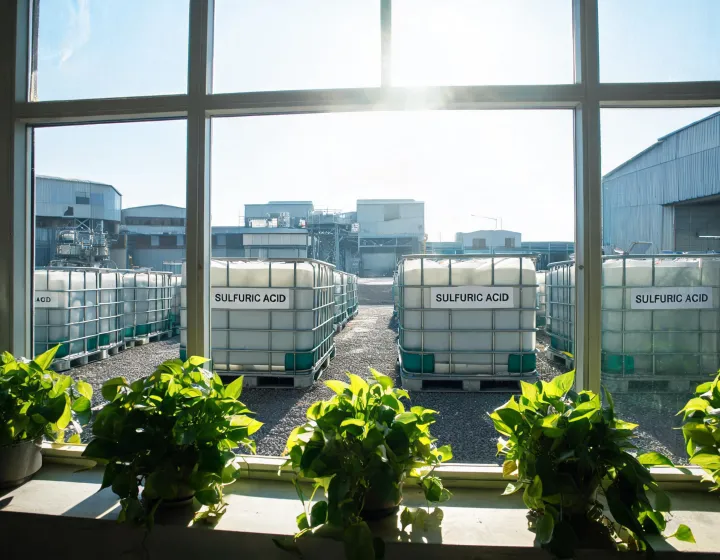
Concentration that works for pH adjustment is not automatically the right assay for phosphate digestion or steel pickling. Package that fits a tote dock may be refused at a bulk unloading arm. Those differences belong on the RFQ, not in a generic industry slogan.
Application and spec matrix
What each use still has to specify before quoting sulfuric acid distributors
| Use context | Typical purchase questions | Documents to request | Open limits |
|---|---|---|---|
| Phosphate / fertilizer digestion | Assay, iron and color limits if the process uses them, bulk vs IBC, US plant city, fill frequency | SDS, TDS, CoA format, transport classification for the quoted concentration | Site cannot treat family SDS as the quoted product; handling stays with site EHS |
| Metal pickling / surface prep | Concentration, residue, replenishment volume, spent-acid policy owned by the plant | Exact-product SDS and CoA; no process recipe is supplied here | Pickling practice is a plant decision, not a sourcing-site instruction |
| Battery-electrolyte blending | Grade name, water content, trace metals if the formula uses them, sample size | TDS plus CoA template; UN 2796 questions stay with the quoted concentration | Battery language cannot be copied from a 98 percent technical-grade quote |
| Water treatment and pH control | Assay, density, package that fits the skid, US plant city, fill frequency | SDS for the quoted concentration, not one sheet for a whole family | Dosing practice stays with qualified operators |
| Distributor replenishment | Package mix, pallet pattern, labeling language, warehouse destination, forecast vs firm order | SDS for each quoted concentration | Distributor status of a factory is not implied by this website |
Selection trade-offs buyers still have to decide
Industry dispute assets for this catalog are empty, so the comparison stays on objective trade-offs. Technical-grade sulfuric acid usually carries a lighter documentation set than reagent or battery-electrolyte grades; asking for the heavier pack on a technical need adds cost and time without changing chemistry. Drum and IBC packs reduce site engineering versus tank-truck or railcar receipts, but they change unit economics and residual heel. Tight assay with wide impurity limits is a different product from a looser assay with tight iron or color control. None of those choices is declared correct on this page; they are fields the RFQ must settle.
Public family references such as SpecialChem product-family pages frame specification questions only. Continue to the inquiry options, matching desk or specification brief when the application row is filled.
Document questions by use
Limits this sourcing desk will not convert into advice
- No mixing, dilution or neutralization procedure is published. Those steps follow the exact SDS and qualified personnel.
- DOT or IMDG classification is requested from the supplier for the quoted concentration and destination; this site does not assign UN numbers.
- TSCA, REACH, GMP and ISO remain supplier-product evidence. They are never restated as Sulfuric Acid Supplier Sourcing credentials.
- Application fit is confirmed by the buyer laboratory or process owner after samples or CoA review, not by a website use list.
Send the plant context with the chemical brief
Name the use, destination constraints and documents still missing. We compare factory wholesale quotations on that basis only.